In Contrast: Two different results, two different Fabregas performances

There was one clear contrast between the Newcastle and Wolverhampton games, which revealed the difference between a 1-0 defeat and a 2-0 win. That contrast was Cesc Fabregas.

Fabregas had one of his worst ever performances in an Arsenal shirt against a determined Newcastle side on Sunday, and that game ended in defeat. Of course there are more factors than just Cesc, but his performances are a fascinating strand of this story.

Against Newcastle Cesc misplaced almost 27% of his passes during the game, and this epitomised the way Arsenal played as a team on the day. In the end the team found little rhythm or flow, and were beaten deservedly.

Continue reading “In Contrast: Two different results, two different Fabregas performances”

An In-depth Look at Greek Super League Playoffs: In Bed With Maradona

If you are interested in world football, then you might just like my latest post over at In Bed With Maradona.

My first article looks in detail at the implications of the Greek Superleague’s decision to introduce a playoff system for European qualification, and the feasibility this might have in the Premier League as it was proposed and backed by some clubs, but opposed by Wenger and Arsenal.

PAOK AEK and the Big Fat Greek Playoffs Last season Premier League bosses controversially proposed a playoff system to decide the qualifiers for the European places. The Greek Superleague or Σούπερ Λίγκα Ελλάδα (literally soo-per liga Ellada) has used a version of the system since 2007-2008, and in some ways, the Greek model could serve as a test for any wider applications…

Continue reading on IBWM

Arsenal Score Six: How they took Braga apart: Highlights of The Fab Four – Wilshere, Fabregas, Arshavin, Chamakh

As Marouane Chamakh left the field last night, his name reverberated around the stadium, and for good reason. The striker has been a breath of fresh air for an Arsenal side which has all too often struggled with injuries up front. Together with the passing of Wilshere and Fabregas, and the movement of Arshavin, Arsenal pulled a new Braga side apart last night, scoring six goals.

Technically Chamakh is gifted, but this is only one of his strong points. He has the ability to create space for others, in holding the ball up superbly with a mixture of balance, strength and exquisite control. His touch is good enough that he generally holds on to the ball, even in very difficult situations, and his aerial strength means he can win headers and make knock downs.

Continue reading “Arsenal Score Six: How they took Braga apart: Highlights of The Fab Four – Wilshere, Fabregas, Arshavin, Chamakh”

Braga’s Brazilian counter-attacking analysed: Champions League Scouting – Arsenal vs. Braga

Os Arsenalistas are about to face their namesakes, in a clash which sees Europe’s most consistent Champions League Qualifiers, Arsenal, take on S. C. Braga in their first campaign.

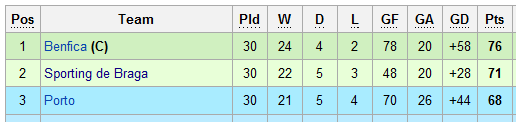
The 2009-2010 league season was excellent for Braga. Under Domingos Paciência they led the Portuguese league for much of the season, losing out to Benfica in what was a two horse race. Finishing second was still an unprecedented achievement for a club generally considered inferior to the ‘Big Three’ – Benfica, Porto and Sporting Lisbon.


The 2009-10 Liga Table

Continue reading “Braga’s Brazilian counter-attacking analysed: Champions League Scouting – Arsenal vs. Braga”

Astute purchases pay dividends – Koscielny and Squillaci tested by Bolton

In seasons past Arsenal have been stereotyped, not without reason, as defensively fragile and naive. Arsene Wenger has sought to address that this season with the signings of two new centre backs, Laurent Koscielny and Sebastien Squillaci after a clear out of the defensive deadwood within the squad.

Against Bolton the back four was totally untested, consisting of Gibbs, Koscielny, Squillaci and Eboue. Last season the equivalent rotation would have left Arsenal with players like Silvestre at the back, players who never inspired confidence at the best of times.

Koscielny made only his third appearance for the club, whilst Squillaci made his debut, and apart from one obvious error from Koscielny they coped well with the threat of the physical Kevin Davies, Lee and Elmander.

Continue reading “Astute purchases pay dividends – Koscielny and Squillaci tested by Bolton”

Understanding the development of Theo Walcott – Positioning and technique: Analysis and Discussion

Theo Walcott has been subject to a rollercoaster of criticism and praise in the five years since signing for Arsenal in January 2006. Here we attempt to understand the evolution of his game. Before signing Theo, Arsene Wenger highlighted some of the key attributes of his game which are all running themes in his development as a player – pace, positioning, and decisions:

“I like the timing of his runs, his determined attitude, the fact that he can play in different positions up front and that he is calm in front of goal…The composure he shows in decisive moments doesn’t change, whether it’s in division one or the Premiership – you have that or you don’t have that. He has determination as well as electric pace.”

That Theo’s pace would be his main attribute in striking fear into defences was apparent from his debut for Southampton against Wolves in 2005, and the use of pace was clear in many of his early goals at Southampton. However, positioning is key in bringing the best out of players, and Walcott needed to be placed carefully to allow his game further to become effective at the top level.

Continue reading “Understanding the development of Theo Walcott – Positioning and technique: Analysis and Discussion”

Marouane Chamakh: His playing style analysed in detail – Bordeaux and Arsenal Scouting

Having discussed the tactical possibilities available to Arsene Wenger with new signing Marouane Chamakh, it seems appropriate to follow up with a more detailed study of the way Chamakh actually plays, based on matches he played for Bordeaux in 2009-10.

Under Laurent Blanc Bordeaux used a clear 4-2-3-1 formation, relying on attacks from the wings, with Gourcuff running the centre of midfield. The team played good football, building possession from the back, and attacking with three creative players and Chamakh. Their formation is visible in this screenshot of the Lyon vs. Bordeaux Champions League Quarter Final first leg in 2010. The fullbacks are marked orange, the holding midfield yellow, attacking midfielders in blue, and Chamakh as striker in pink.

Chamakh played a crucial role for Bordeaux, leading the line and scoring goals, a constant threat to defenders. His style does not involve running with the ball or outpacing opposing defenders, but rather linking up with midfielders, and holding up the ball, in the ‘false nine’, and converting crosses in the box.

Continue reading “Marouane Chamakh: His playing style analysed in detail – Bordeaux and Arsenal Scouting”

How Marouane Chamakh can slot into the Arsenal system: Tactical Analysis 2010 – 11

Marouane Chamakh could essentially pose Arsene Wenger a selection problem this season if Arsenal stick to their current tactical set up, but ultimately he provides excellent cover for a team which has been stretched far too often over the previous few years.

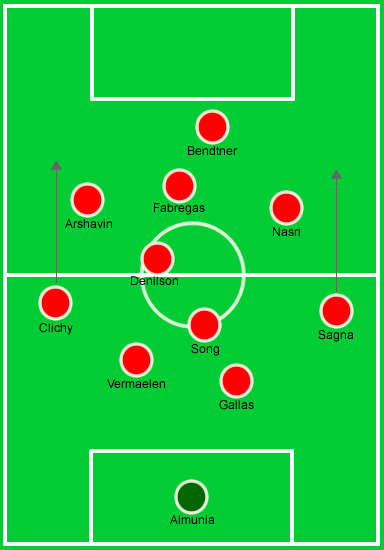
In 2009 – 10 Arsenal played with what was widely regarded as a 4-3-3, but in effect was a fluid 4-2-3-1 formation. This consisted of two central midfielders holding the centre of the park, whilst Fabregas played between the lines. Two wide players, usually Arshavin and Nasri, looked to cut in from the flanks, whilst a single striker played as a ‘false nine’, dropping deep.

Chamakh At Bordeaux

Chamakh actually has the attributes to play in 4-2-3-1, as he played the stiker’s role in this formation at Bordeaux. The team played two slightly deeper central midfielders, with attacking support from three forward midfielders. Their line-up against Bayern Munich in last season’s Champions League is a good example of  Bordeaux’s system in action.
Continue reading “How Marouane Chamakh can slot into the Arsenal system: Tactical Analysis 2010 – 11”

Why Nicklas Bendtner couldn’t save Denmark: World Cup 2010 Tactical Analysis

Nicklas Bendtner is well known for his self confidence in the Premier League, and has been subject to criticism in the past over his performances. Without a doubt he is a talented player, however he may not be the superstar that he and his father bill him to be.

Nevertheless Nicklas did come up with several important goals during 2009-10 and often had to lead the line on his own for Arsenal, a tough task considering his age.

Denmark used Bendtner as their main striker in the World Cup in South Africa, their preferred formation was 4-2-3-1, meaning he was the solitary front man, a tough task for any young player. Indeed, he didn’t manage to pull them through in the final group game where they lost 3-1 to Japan and missed out on the Second Round.

Continue reading “Why Nicklas Bendtner couldn’t save Denmark: World Cup 2010 Tactical Analysis”

High Hopes for Löw & His Young Talent: World Cup 2010 Germany’s 4-2-3-1. On Talking About Football

The latest tactical comment on the World Cup, in our joint analysis with Talking About Football. This time we look at Germany’s system. A young and exciting team, who lack experience, something which sounds more than a little like Arsenal.

Low plays a 4-2-3-1 system, and like to get the full backs forward in attack. Pressing is the name of the day, and the team will look to counter-attack rapidly through their forward players.

High Hopes for Löw & His Young Talent: Germany 2010 German coach Joachim Löw is a tactical innovator who can use several systems to suit different situations. They are essentially similar systems, just variations on a theme, based around the 4-2-3-1 formation which he used successfully in Euro 2008. The German team is solid, and impressively conceded just 5 goals in qualification for South Africa 2010, losing no games. They are high achievers, reaching the Semi-finals of the World Cup in 2006… Continue reading on Talking About Football